#89. What Would Steve Do?
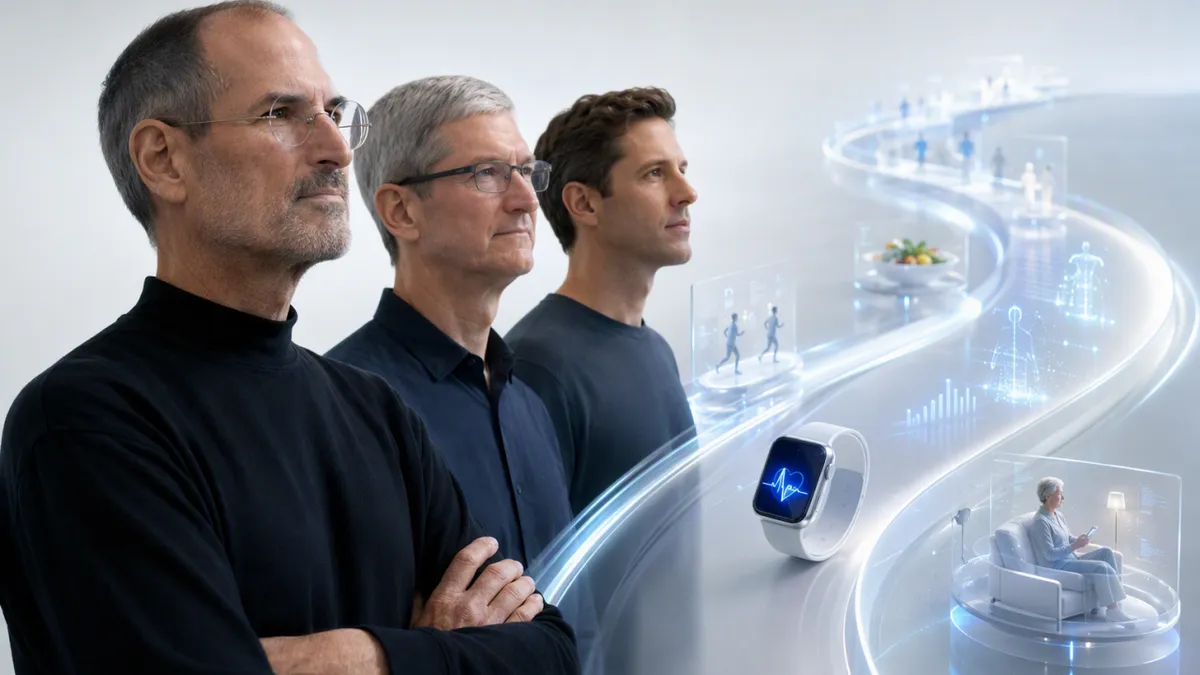
This week Apple entered a new era as John Ternus succeeded Tim Cook as CEO. Most articles I’ve read this week have explored what Ternus will do in his new role, but as a long-time admirer of Apple, and of Steve Jobs in particular, I found myself thinking about a different question.
What would Steve Jobs do if he were still running the company today?
And in particular what would he do in health. Not because Jobs was a healthcare visionary. He wasn’t. Healthcare barely featured during his time at Apple. But throughout his career he repeatedly demonstrated an ability to look at established industries and ask a simple question: why is this so complicated?
The music industry, mobile phones, personal computing and animation all looked one way before Steve Jobs and another afterwards. If he were looking at healthcare in 2026, what would he see that the rest of us have missed?
This is obviously an impossible question to answer. But if there is one thing Steve Jobs consistently demonstrated, it was an ability to identify complexity that entire industries had simply learned to tolerate.
And if he walked into healthcare today, I suspect the first thing he would notice is that we have spent the last twenty years digitising healthcare without necessarily making it easier to use.
We have built Electronic Health Records, patient portals, interoperability standards, integration platforms, and increasingly AI-powered tools. Yet clinicians still spend too much of their day navigating systems, hunting for information, and completing administrative tasks that contribute little to patient care. Patients still tell the same story multiple times. They still navigate fragmented services. And they still act as the connective tissue between organisations that struggle to share information effectively.
For all our technological progress, the experience often remains depressingly analogue.
Which brings me back to my original question.
I don’t think Steve Jobs would have started by asking how to improve healthcare technology. I think he would have started by asking why healthcare remains so difficult to navigate in the first place.
Patients don’t experience healthcare as hospitals, GP practices, pharmacies, community services and specialist clinics. They experience it as one thing: their health.
Yet we’ve built a system that is largely organised around organisations, professional boundaries and administrative processes rather than around the individual.
The technology industry solved this problem years ago. Nobody thinks about which server stores their photos, which network routes their message or which database holds their music. The complexity exists, but it has been hidden from view.
Healthcare has taken a different path and we continue to expose much of that complexity to patients and clinicians every day.
And that is where I suspect Steve Jobs would have focused his attention.
I think he would have been fascinated by the fact that despite enormous advances in technology, managing your health is still often harder than managing your finances, booking a holiday or ordering a taxi.
Patients are expected to know where to go, who to contact, what information to bring and how different parts of the system fit together. Clinicians are expected to navigate an ever-growing landscape of records, portals, workflows and administrative processes.
The complexity is understandable. But that doesn’t mean it should be accepted or visible. That was often the genius of Steve Jobs.
He didn’t eliminate complexity, but he did look at problems from a first principles perspective.
That makes me wonder whether Jobs would have viewed AI differently from many health leaders today. Many conversations about AI focus on productivity. How do we generate clinic letters faster? How do we complete documentation more efficiently? How do we automate repetitive tasks?
All important questions, but they all assume that today’s model of healthcare remains largely unchanged. Jobs rarely worked that way.
Instead, I suspect he would have asked how do we make healthcare feel effortless.
Not by replacing doctors, nurses or human judgement. But by removing friction from every interaction around them.
But ultimately, the goal isn’t a better experience. The goal is better outcomes.
Less time spent documenting means more time spent caring. Less time searching for information means better clinical decisions. Earlier access to the right information means earlier intervention. Continuous monitoring means conditions can be identified before they become emergencies. Health systems become more proactive, more preventative and more personalised.
One more thing…
Steve Jobs didn’t change industries by simplifying technology. He changed them by helping people do things they couldn’t do before.
If he were looking at healthcare in 2026, I suspect he would see AI, interoperability, digital platforms and wearable technology not as the destination, but as the foundations of a system that helps people live longer, healthier and more independent lives.
- A health system that finally organises itself around the individual rather than the institution.
- A health system where information follows the person, not the organisation.
- A health system where clinicians spend more time caring and less time navigating complexity.
Ultimately, a health system that helps people live longer, healthier and more independent lives.
Read more: https://www.nytimes.com/2026/09/01/technology/apple-tim-cook-john-ternus.html
Watch some classic Jobs: https://youtu.be/MnrJzXM7a6o?is=aQRSaP57aJikizDf
Originally published on LinkedIn.