#95. Regulating the model that keeps changing
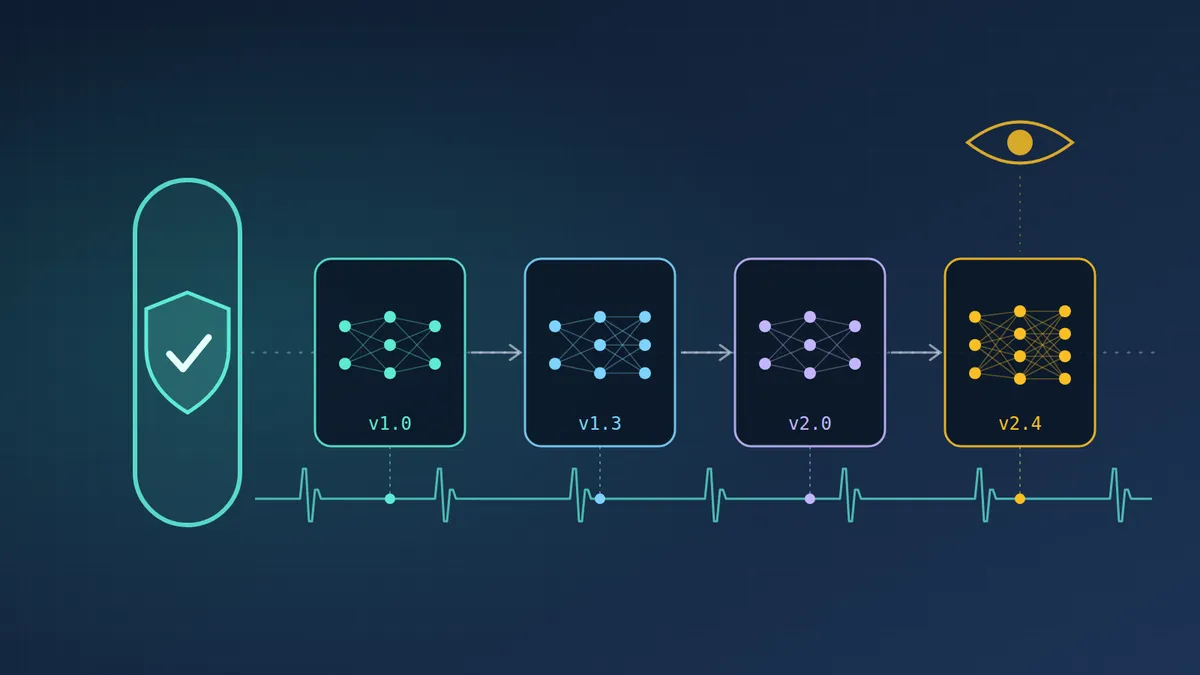
Most medical devices do not change after they are approved. A hip implant on the day of approval is the same hip implant ten years later. AI does not work like that. Models are retrained, fine-tuned and swapped out underneath products, sometimes every few weeks.
In the space of nine days, the UK has set out how it intends to regulate that. On 6 October the government accepted all 44 recommendations of the National Commission into the Regulation of AI in Healthcare. On 14 October the MHRA published its strategy to 2030, with a new Centre for AI and Digital Health and a promise of an “adaptive” framework for AI as a medical device.
Taken together, this is an emerging view of how AI in UK healthcare will be regulated. There is a lot to like, some reason for caution, and a wider question: who does the work once the regulator stops treating approval as the finish line.
What was announced
The two announcements fit together. The Commission set out what needs to change, and the MHRA strategy says how the regulator will organise itself to do it.
From the government’s response to the Commission (GOV.UK):
- Draft guidance by December 2026 on managing changes to AI-enabled medical devices as they adapt over time.
- “Staged” authorisation, so that promising AI tools can be used in the NHS earlier, under close supervision, while real-world evidence is gathered.
- AI Airlock Phase 3, the MHRA’s regulatory sandbox, now funded for three more years and focused on monitoring AI devices after deployment. The first wave is selected in November.
- A full implementation roadmap by spring 2027.
From the MHRA’s 2030 strategy (GOV.UK, MedTech explainer):
- A Centre for AI and Digital Health to set clearer expectations for developers of AI-driven devices and medicines.
- A “modern, adaptive regulatory framework for AI as a medical device”.
- Expanded Predetermined Change Control Plans, so that model updates agreed in advance can go ahead without a fresh approval each time.
- Exploring master files for foundation models, so the developer of an underlying model can share safety and performance information once, rather than every product built on it starting from scratch.
- Real-time safety monitoring using real-world NHS data, AI-assisted signal detection and a simpler Yellow Card scheme.
Why AI breaks the old model
The Commission describes the problem as follows: current approaches “were largely designed for products that are more static”. Under the traditional model, a manufacturer proves a device is safe, gets it approved, and changes to it are the exception. With AI, change is the normal state.
That creates two problems. The first is that a model which passed its evaluation can drift as patients, workflows or data change around it. The second is that the model underneath a product can change without the product’s name changing. An AI scribe bought in January may be running a different foundation model by June.
The proposals attempt to address both. Change control plans let a developer say up front which changes it will make and how it will test them, so regulators approve the process rather than every release. Foundation model master files deal with the layer most buyers never see. Staged authorisation and real-world monitoring accept that some evidence can only be gathered in use.
On paper this is sensible, and it follows the path the US FDA took when it finalised its guidance on change control plans for AI-enabled devices in December 2024. But it also shifts weight from the moment of approval to everything that happens after it, and that has costs.
Who does regulation protect?
There is a counter-argument, and it is being made loudly in the US. Regulation designed with the help of the largest companies can become a wall that only the largest companies can climb. Some technology investors and policymakers have accused frontier AI labs of lobbying for rules that would lock in their lead. More broadly, every month a useful tool waits for approval is a month patients don’t benefit from it, and that cost is harder to see than the cost of a tool that goes wrong.
Some of that applies here. Take the fast track. The MHRA will “introduce a new higher value service option for medicine and medical product developers to fast-track the scientific advice service from 90 days to 45 days” (GOV.UK). Scientific advice is where a developer asks the regulator, before building its evidence, what it will need to show. Getting that answer in six weeks rather than three months is a real advantage.
But does a “higher value” option cost more? If so, the well-funded developers are the ones who can buy the shorter queue. The strategy pairs it with a “targeted voucher scheme” to reduce barriers for start-ups and smaller companies, but has not said how big that scheme is or who qualifies. Whether the two balance out depends on details not yet published.
If foundation model master files go ahead, they could make the handful of firms that hold them gatekeepers, and it is not yet clear how a start-up building on an open-source model would get the same treatment. Each new layer of assurance (DTAC, DCB0129, MHRA registration, the AVT registry, now change control plans) is a fixed cost that a 20-person UK company feels far more than a global vendor does.
But the evidence from UK healthcare so far is more mixed than the “moat” argument suggests. In AVT, specialist scribes have won the largest regional deals, while the large EPR vendors’ bundled products were the ones missing MHRA status or registry listings. Medical devices have always been regulated, so the real question is not regulation or none, but whether the new regime is proportionate. Much of what was announced, from staged authorisation to the AI Airlock sandbox and a start-up voucher scheme, is aimed at lowering the cost of entry rather than raising it.
The fair test is what happens next:
- Who gets the fast lanes: whether the fast track, vouchers and Airlock places reach small UK and Irish firms or mostly go to incumbents.
- Who holds the master files: whether open-source and smaller models can use the same route as the big labs.
- Who is in the room: whether the spring 2027 roadmap is shaped by clinicians, patients and smaller suppliers, or mainly by the largest vendors.
Who watches the model after go-live?
Lifecycle regulation needs lifecycle capacity, and much of that sits with providers, not the MHRA. The regulator can approve a change control plan. It cannot see how a model behaves in a particular outpatient clinic on a Tuesday afternoon. Under DCB0160, that is the deploying organisation’s job.
In #91 I wrote about the clinical safety gap: of 14,848 digital health technologies in use across NHS trusts and ICBs, 70% had no documented safety assurance. An adaptive regime adds to that work. Every pre-approved model update is a change the deploying organisation still has to understand, test locally and sign off. Staged authorisation means using tools while the evidence is still being gathered, which only works if someone is gathering it.
The same capacity question runs through recent weeks. NHS England’s board says flagship digital programmes are slowed by “limited capacity within providers to implement change”. An HTN survey this month found 57% of respondents think the NHS lacks the digital leadership capacity to deliver its ambitions. And in #94 the limiting factor on Epic’s patches was not the fix, but how fast each organisation could safely deploy it.
There are good examples. Rotherham, Doncaster and South Humber, rolling out an AI scribe in mental health, has a published AI policy that names the chief executive and clinical safety officer as accountable. That is the kind of local governance an adaptive regime assumes exists everywhere. It does not yet.
Ireland and Northern Ireland
Ireland is building its approach from the other end. The EU AI Act and EU medical device rules govern the products, and Ireland’s Regulation of Artificial Intelligence Bill 2026 sets up an AI Office to implement the Act. What Ireland has added is guidance on use. HIQA’s first national guidance on the responsible and safe use of AI, published this summer, is built around accountability, human rights, safety and responsiveness, and applies to every health and social care provider.
That is a useful contrast. The UK is investing in the regulator’s ability to manage change. Ireland is setting out what providers are expected to do. Each needs the other half: an adaptive device regime depends on providers who can monitor, and provider guidance depends on products whose changes are visible.
Northern Ireland sits between the two. Its health minister welcomed the Commission’s recommendations alongside Wales and Scotland, but under the Windsor Framework medical devices placed on the NI market follow EU rules and need CE marking. For HSC organisations buying AI tools, both regimes matter.
What this means
- For trusts and HSC organisations buying AI: ask suppliers for their change control plan before you sign. Which model updates are pre-agreed, how will you be told, and what do you need to re-test locally?
- For clinical safety officers: an adaptive regime moves work towards you, not away. Budget for monitoring after go-live, not just the DCB0160 case at launch.
- For suppliers: the MHRA is signalling that the underlying model matters. Expect buyers to ask which foundation model sits under your product and what happens when it changes.
- For Irish buyers: HIQA’s guidance sets the expectations for use. Ireland’s national EHR and AI for Care programmes can write UK-style change control requirements into contracts now, without waiting for a regulator.
- To watch: the MHRA’s draft guidance on adaptive devices in December, the AI Airlock’s first Phase 3 cohort in November, and the full roadmap in spring 2027.
Also worth reading this week
- An £838m “open” framework for GP IT. NHS England’s new framework has three lots: foundation clinical systems, supporting tools including AI and remote monitoring, and research and development. It opens to bids in November and reopens at set intervals.
- AVT buying goes regional. Imperial, Chelsea and Westminster, London North West and Hillingdon are shaping a joint procurement for ambient voice technology from April 2027. It follows the regional pattern from #93.
- NHS Online takes shape. Kainos has won a £9.9m contract to build the clinical workflow for the new virtual hospital trust, which goes live in 2027 and aims for up to 8.5m appointments in its first three years.
- Who’s in the room. A KFF Health News investigation, reported by Fierce Healthcare, found a US CMS-run Slack group of around 1,700 members, mostly tech firms, shaping policy on app access to patient records. There were only a handful of patient advocates and clinicians. A reminder that how AI rules are written matters as much as what they say.
Read more
- Government backs recommendations of NHS doctors-led AI Commission – GOV.UK
- MHRA 2030 strategy to modernise patient-centred regulation – GOV.UK
- MHRA Strategy 2030 – GOV.UK
- MHRA 2030 strategy vows to create modern framework for AI as a medical device – HTN
- HIQA publishes first national guidance on AI in healthcare – Pulse+IT