#98. America hits reset on health IT regulation
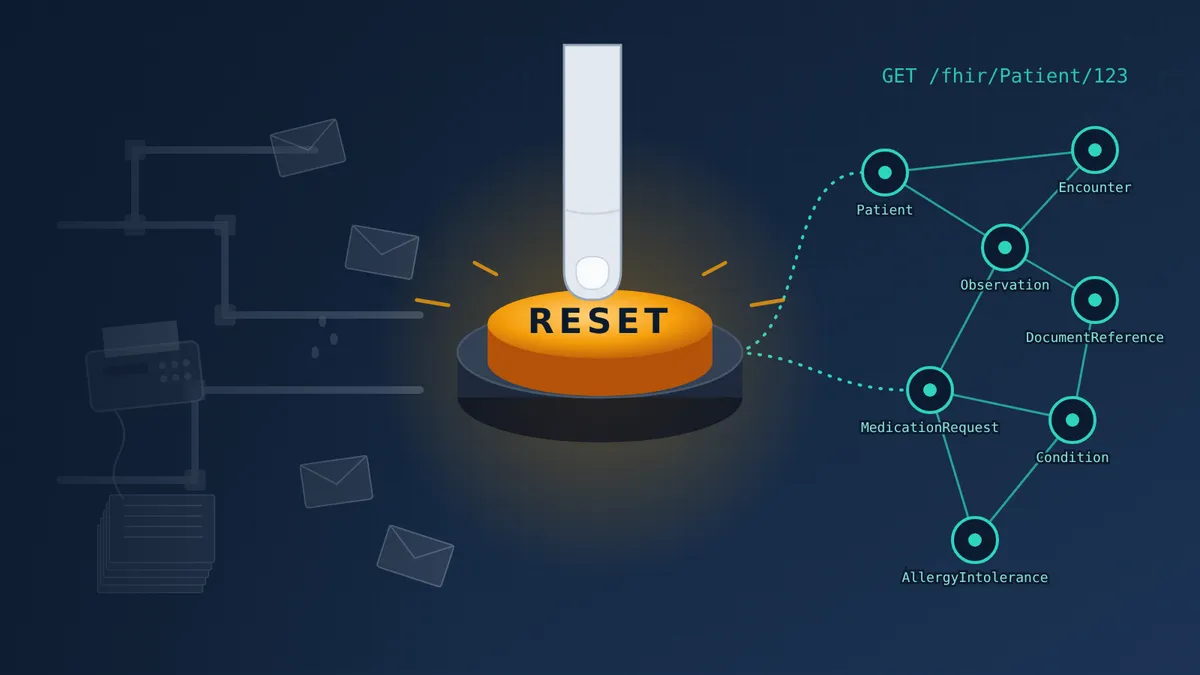
If you work in UK or Irish healthcare you may not be overly familiar with US health IT certification, but its likely you work with or alongside software that is shaped by it every day. At the end of October the US cut it back sharply in a deliberate move away from old ways of sharing data towards new ones.
What US certification is
In the US, the Office of the National Coordinator for Health IT (ONC) runs a certification programme for electronic health record (EHR) software. Since the HITECH Act of 2009, US hospitals and doctors have had to use certified EHRs to qualify for federal incentive payments, and later to avoid penalties. That gave certification teeth. To sell in the US, a product had to pass ONC’s tests. Can it record allergies? Can it send a summary of care in a standard format when a patient is referred? Can patients download their records, or connect their own apps?
ONC updates those tests through a series of rules. The recent ones are called HTI, short for “Health Data, Technology, and Interoperability”. HTI-1, for example, added transparency requirements for AI and decision-support tools in the record. HTI-5 goes the other way. It is explicitly a deregulatory rule.
Why does that matter here? Many hospitals in the UK and Ireland run, or are buying, EHRs built for the American market, and those products are designed to pass US certification. So the US checklist will shape what buyers here can expect, even though nobody here wrote it.
What HTI-5 changes
The US Department of Health and Human Services finalised HTI-5 on 26 October and projects more than $1.5 billion in regulatory cost savings. The Secretary’s framing was clear: “American doctors and patients need better technology, not more Washington paperwork.”
According to ONC, the programme had 60 criteria. HTI-5 removes 14, revises 7 and keeps 39. Most of what goes is older functionality and older ways of exchanging records, such as sending documents between providers. The modern FHIR-based standard for sharing data between systems and apps stays as a requirement.
Requirements to test products in real-world use and report on them are also scaled back. ONC says it is laying “a new foundation” built on FHIR that can “support creative AI-enabled interoperability solutions”. Proposed changes to the US rules on information blocking, which stop providers and vendors from unreasonably withholding patient data, have been put off for now.
A reset, not just a cut
The final rule of HTI-5 says that “America’s interoperability arc in healthcare has bent decisively toward” FHIR-based APIs, and that clearing out the older criteria “will enable ONC to reset the Certification Program’s regulatory scope”.
That is a deliberate move away from old plumbing and old ways of sharing data. Rather than keep certifying both, ONC is backing the newer approach and letting the older ones go.
ONC is also clear that it wants FHIR APIs that enhance automation, “move beyond read-only interactions” and expand the data available. The rule even names Model Context Protocol (MCP), a standard for connecting AI models to other systems, as the kind of successor technology the law allows for.
Legacy standards and interfaces rarely get switched off. They pile up, and every new system has to support all of them. Deciding what to stop doing is as much a strategy as deciding what to start.
There is a reasonable case for the reset. Many of the removed criteria certify functions every mature EHR already has, or standards that have been overtaken. Certification that checks a feature exists says little about whether it works well in practice. Betting on modern APIs rather than a growing list of feature tests is a defensible choice.
What makes vendors follow
So who pays for the reset? Nobody in this case - HTI-5 comes with no new money. ONC estimates it adds no compliance costs for developers and saves $1.55 billion over time. So why would vendors move to the new requirements?
- Certification is, in practice, a requirement to sell to US providers. US hospitals and clinicians must use certified EHR technology to take part in Medicare’s Promoting Interoperability programme and the interoperability part of its clinician payment scheme, MIPS. Hospitals that fall short face lower Medicare payments.
- Blocking data is expensive. Developers of certified health IT that engage in information blocking face civil penalties of up to $1 million per violation, and can lose their certification. HHS announced a crackdown in September 2025.
- Recognition, not payment. CMS’s voluntary Interoperability Framework asks networks and vendors to meet criteria including FHIR APIs. Those that do are listed as “CMS Aligned Networks”.
When HITECH began in 2009, the US paid providers to adopt certified systems through the HITECH incentives. Now it relies on what providers must buy and what vendors must not do.
Two directions at once
The contrast with Europe is interesting. As the US removes requirements, the European Health Data Space (EHDS), the EU law that will govern how health data is shared across member states, is adding them, with common requirements for EHR systems including interoperability and logging. The EU AI Act layers obligations on clinical AI on top of that. My piece last week noted one consequence: OpenEvidence withdrew from the UK and EU, citing the AI Act.
The UK and Ireland sit between the two. Ireland will follow the EHDS. The UK has its own standards and assurance, but often buys from the same global vendors.
What this means here
- Don’t treat US certification as assurance. It now checks less, so procurement needs to ask directly about the things it no longer covers, such as decision support, sensitive data labelling and audit.
- Do our own reset. Legacy interfaces and document-only exchange rarely get switched off here either. Health systems should decide which ones they will retire, and set dates, rather than ask every new system to support all of them.
- Standardise on one set of FHIR profiles. Agree the national profiles and write them into every procurement, so vendors build once rather than to each buyer’s variation.
- Decide how AI gets into the record. ONC wants APIs that go beyond read-only, and the rule names MCP, so AI tools will increasingly write into records, not just read them. That is already happening with ambient voice technology drafting clinical notes, and agents will follow. Health systems need clear rules on what AI can write, through which interfaces, with what audit trail, and when a clinician must sign off.
#FundingAndGovernance #InterconnectedInfrastructure #TheDataAndDigitalEngine