#93. Patterns of Enterprise AVT
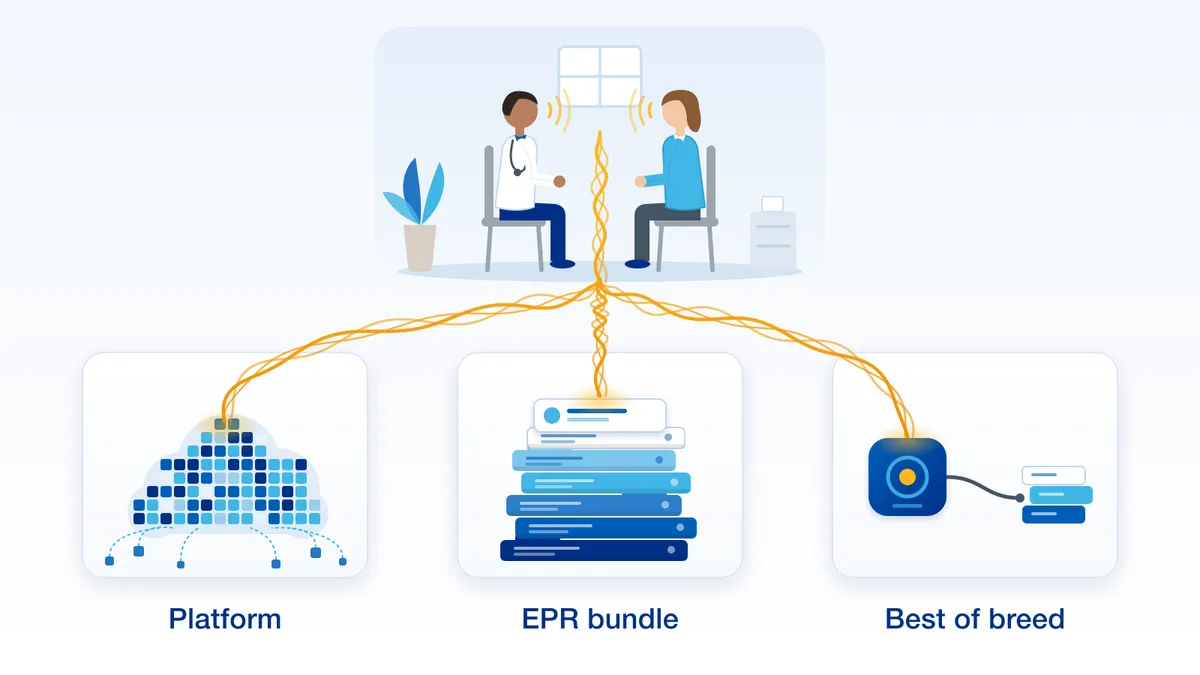
Walk the floor at HETT this week (as I did) and you could be forgiven for thinking ambient voice technology (AVT) is one product. It was on half the stands and in most of the talks. But “AVT” now covers several different ways of buying the same capability, and healthcare organisations are already splitting along those lines.
How a trust buys AVT decides who owns the clinical safety case, where the data goes, how it reaches the record, and how hard it is to switch later. This piece sets out the patterns I see, who sits in each, and which kinds of buyer are choosing which.
Pattern 1: the platform play (hyperscalers)
Only one hyperscaler is currently selling a finished AVT product directly to NHS and Irish healthcare providers, and that is Microsoft. The others mostly turn up as components inside someone else’s product.
Microsoft launched Dragon Copilot in the UK in September 2025, after a preview with seven UK and Irish organisations and more than 200 clinicians, including Manchester University NHS FT. It merges Dragon Medical One dictation with DAX ambient listening, holds MHRA Class I status, and is sold through partners and existing frameworks.
AWS offers HealthScribe as an API that software vendors build into their own products, rather than selling to hospitals itself. In 2026 it widened this into Amazon Connect Health.
Google has no B2C UKI ambient scribing deal that I’m aware of, but let me know in the comments if this is not correct.
Who buys this: for Microsoft, organisations already standardised on Microsoft and/or Dragon Medical One. For them Copilot is an upgrade to an existing contract rather than a new procurement. The pitch is one voice platform for dictation and ambient, across any EPR.
For AWS, the buyer is not usually a healthcare organisation. It is the software supplier, which builds HealthScribe into its own product and sells that on.
Pattern 2: bundled (AVT inside the EPR)
The big EPR suppliers now sell AVT as a module of the record itself. NHS England’s chief digital officer Rob Thompson has said national guidance will treat AVT integrated with the EPR as the baseline, because unintegrated AVT “not a good thing”.
These products often sit on hyperscaler technology, with a twist:
- Epic AI Charting is built with Microsoft. Microsoft supplies the Dragon ambient technology for transcription and speaker separation, and the models run on Azure. Epic says customers can still use third-party scribes.
- Oracle Health Clinical Note runs on Oracle’s own cloud, OCI. Oracle is the one EPR vendor that is also a hyperscaler. It went on general UK release in February 2026 after pilots at Barts, Imperial and Milton Keynes.
- System C has a CareFlow ambient outpatient module. Buckinghamshire Healthcare is the first trust, with go-live planned for summer 2026.
Who buys this: large single-EPR trusts that have already made the big platform bet. Barts is a good example. It now has more than 2,000 clinicians with access to Oracle’s tool and 700 active users in September.
The friction is regulatory. In April 2026 Frimley Health halted an Epic AI Charting trial because the tool had no MHRA Class I status and was not on NHS England’s AVT registry. At launch, Oracle was also missing from the registry. The bundled suppliers are arriving with the best integration but, so far, the thinnest paperwork.
Pattern 3: best of breed (standalone scribes)
The standalone specialists are winning the biggest contracts by headcount, often through regional deals rather than one trust at a time. These suppliers sell the scribe as the product and integrate with whatever record the buyer has.
- Heidi (Australian) is the sole supplier on the NHS Midlands framework covering 1,239 GP practices and about 70,000 clinicians across 15 trusts.
- Lyrebird Health (Australian) is being rolled out by four south west London trusts to 20,000 clinicians.
- TORTUS (UK) ran the GOSH-led nine-site London trial covering more than 17,000 encounters, which fed NHS England’s guidance. It has a pilot at Royal Devon.
Who buys this: two kinds of organisation. The first is the multi-EPR group or region that cannot wait for each EPR vendor to ship its own module, such as the Midlands, south west London, and Royal Wolverhampton with Walsall. The second is general practice, where neither EMIS nor SystmOne offers a native scribe.
In general practice, best of breed often arrives inside something else. Accurx Scribe is a Tandem Health engine sold within a platform that Accurx says 98% of English practices use, so for most practices it is a switch-on rather than a procurement. X-on Health, the telephony supplier, resells TORTUS as Surgery Intellect, with IM1 assurance to write approved notes back into EMIS and SystmOne. The packaging is a bundle, but the product is still a third-party scribe that has to integrate with someone else’s record.
Who buys what, and why
The best predictor of which pattern an organisation picks is not its view on AI. It is the shape of its existing estate. The best predictor of which pattern an organisation picks is not its view on AI. It is the shape of its existing estate.
| Pattern | Examples | Typical buyer | Strength | Watch-out |
|---|---|---|---|---|
| 1. Platform | Microsoft Dragon Copilot; AWS HealthScribe (via partners) | Organisations standardised on Microsoft and/or Dragon Medical One | One voice platform across any EPR | EPR integration is often a separate project |
| 2. EPR bundle | Epic AI Charting, Oracle Clinical Note, System C CareFlow | Large single-EPR acute trusts (Barts, Imperial, Buckinghamshire) | Deepest integration, including coding and orders | Registry and MHRA status lagging; ties AVT to the EPR contract |
| 3. Best of breed | Heidi, Lyrebird, TORTUS, Accurx Scribe (Tandem) | Regions and multi-EPR groups (Midlands, SW London); GP practices | Fastest at scale; strong evidence base | Depends on write-back access the record vendor controls |
Four things stand out.
Policy and procurement are pulling in different directions. NHS England says EPR-integrated AVT should be the baseline. Yet the largest deals by headcount, in the Midlands and south west London, went to standalone suppliers, and the bundled products are the ones short of UK regulatory paperwork. Expect integration standards to become the real test.
The hyperscalers win either way. Microsoft sits inside Epic as well as selling Copilot, and Oracle’s scribe runs on Oracle’s own cloud. Whoever wins the clinician’s screen, much of the compute is rented from a few clouds. Which clouds the standalone scribes run on is less visible, and a fair question for any buyer.
Buying is moving from trusts to regions. The Midlands framework was built to be repeatable by other regions. If others copy it, the market could consolidate to a few sole suppliers per region, with real switching costs. NHS England expects ICBs and providers to adopt AVT from April 2026.
Delivery, not choice, is the bottleneck. This week the NHS England board listed AVT among the digital programmes moving too slowly. Barts shows why: even with the tool live, some clinicians need more time to change how they work. Meanwhile HSSIB is investigating the patient safety risks of AVT in hospitals.
The future: from writing the document to running the workflow
The first generation of ambient technology was essentially:
conversation → transcript → note
The direction of travel is:
conversation → understanding → structured data → workflow → action
That is a much bigger proposition.
Once an AI system understands the consultation, there is no obvious reason for it to stop at producing a note. It could potentially:
- identify follow-up actions
- prepare referrals
- place orders
- support coding
- trigger downstream workflows
Oracle is already moving in this direction with its Clinical AI Agent portfolio, which now includes documentation, coding, chart review and order-related capabilities.
AWS is positioning Connect Health similarly, combining ambient documentation with patient insights and medical coding and making those capabilities available through a common SDK.
Epic’s AI Charting queues orders, while System C’s module completes coding and outcome forms.
And Microsoft is building Dragon Copilot with capabilities and APIs designed to allow partners to integrate the technology into wider applications.
This makes AVT a clinical change and adoption challenge, not just an IT rollout. Clinicians have to learn how to incorporate this new technology in their workflow, and some will take longer than others.
So the question for a trust choosing AVT now is not just which scribe writes the best note. It is who it wants to own the workflow that the note is about to start.
Read more
- Epic rolls out AI Charting – Digital Health News
- Heidi rolls out AI agents – MobiHealthNews
- Microsoft launches ambient AI assistant to the NHS – Digital Health
- Amazon enters health care generative AI market – Bloomberg
- NHS backs rollout of integrated AVT as part of £10bn tech funding – Digital Health
- Buckinghamshire signs System C deal for AI scribing – Digital Health
- Barts Health continues to roll out AVT – HTN